Wakesurfing is one of the biggest watersports on the planet right now, and it’s all thanks to the low-impact crashes, quick learning curve and team aspect of having your crew cheer you on from the boat. Add to this that just about anyone from young kids to grandparents can learn to wakesurf and you’ve got a recipe for the perfect summer sport. And whether you’re a veteran surfer who needs some tips to help teach others or you’re learning for the first time yourself, Axis Pro Athlete Guenther Oka will help you save some falls by instilling some solid fundamentals from setting up your boat, to getting up for the first time, to the basics of riding.
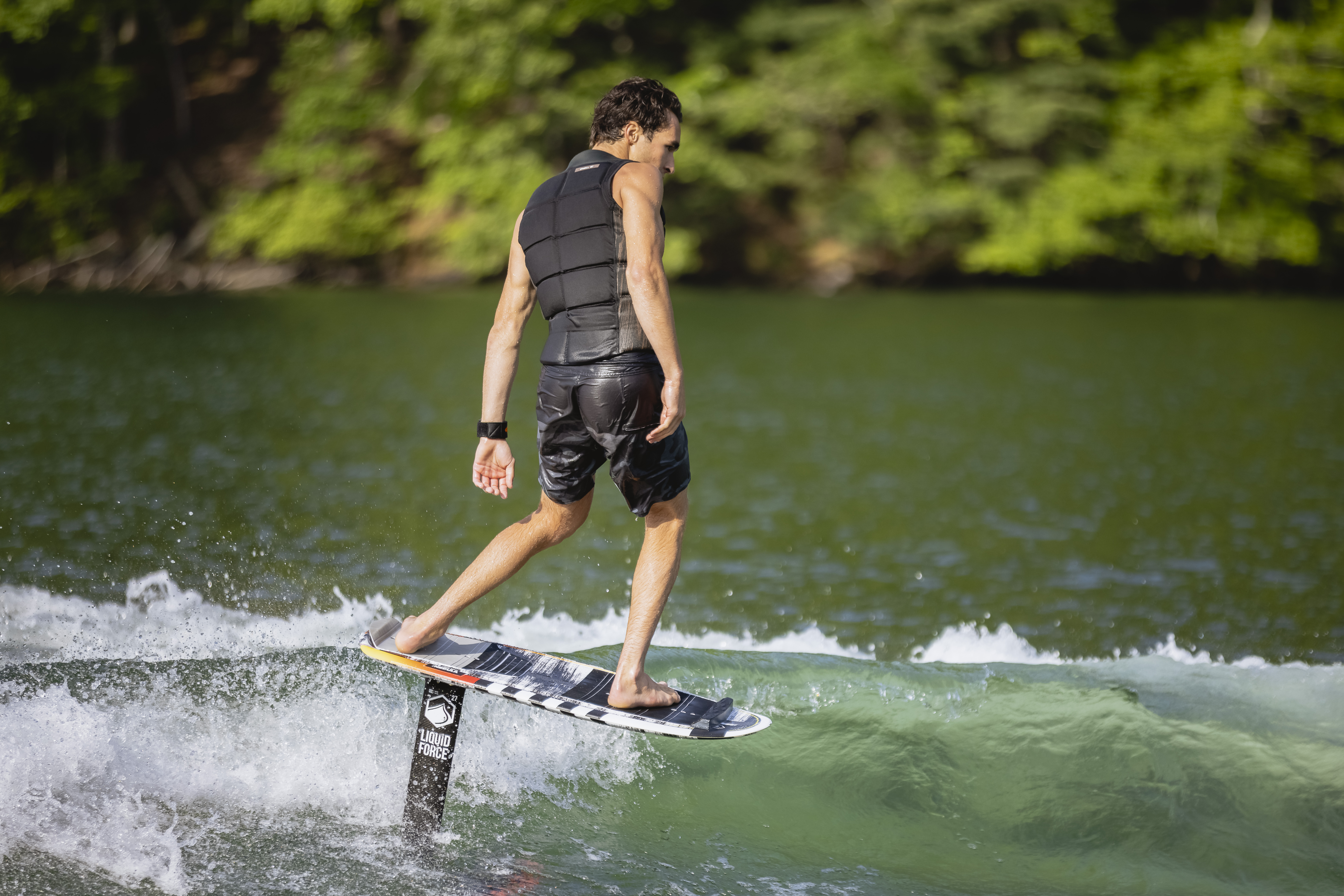
For those who have been surfing for several seasons and want to try a new challenge, wake foiling is the next level. The board is similar to wakesurfing, but the feeling is totally different because you’re floating above the chop on a hydrofoil. Together with Guenther, we’ll cover some of the key foiling points that will help you learn this new sport quickly and easily. You can skip ahead to that here.
HOW TO SET UP YOUR AXIS BOAT FOR WAKESURFING

To begin with, you don’t want a full-size wave with all the drive Axis is known for. It will be too much for first-time riders, so aim for a wave that’s just big enough to give the surfer the feeling of the wave’s push. Make the wave as long as possible by evenly weighting the boat from front to back and setting the Power Wedge® III on 1 or 2. You definitely don’t need full ballast. Less is more with beginners and a smaller wave can help get them up and gaining confidence quicker. Set Surf Gate® to whatever side they want and your speed control to around 10 miles per hour and you’re ready to roll. This setup will create a nice long pocket with a mellow face that’s very forgiving for beginners. When the rider is up and ready for more push from the wave, just empty some of the forward ballast and set the Power Wedge® III to somewhere around 3-6 if they’re surfing regular foot (Left-foot forward). This will create a more steep, powerful wave with plenty of push. To counter prop rotation that naturally occurs with all inboard boats, it can be helpful to set the Power Wedge® III at a lower number when your surfer is on the righthand side; somewhere between 1-4 is usually ideal.
SURFING WITH SURF BAND®

One of the great things about surfing behind an Axis is your wave is customizable while you ride with Surf Band®. You can get the wave close to where you want it while you’re in the boat, then hop behind it and tweak settings while you ride, right from your wrist. Adjust speed and music volume up or down, pick which side you want to surf on, and choose your Power Wedge® III setting without ever having to communicate with the driver.
When you’re ready to switch your surf side, just hit the button for the opposite side and you’ll hear a series of horns telling you when to switch. There will be two short bursts, then a long one. Start back on the wave and pump forward as you hear the first two horns. By the time you’re partway through the longer horn you should be at the front of the wave and hopping over to the other side. This will take some practice, but being able to nail the timing with Surf Band® and the surf horns will mean that with practice you will be able to consistently transfer from side to side.
GETTING UP
Start with the rider on the boat’s sun pad with the wakesurf line in their hands. Have them lay on their back with their knees bent holding the handle high above their head. Pull on the other end of the handle and tell them to think of doing a sit-up at the same time. This helps illustrate that if they were on the ground and you were helping them up, they would do some of the work by bending their knees and trying to sit up at the same time rather than flattening out and resisting you, which is what most people instinctually do behind the boat when they’re getting up on a wakesurfer for the first time. When this is clear in their mind, take it to the water with a buoyant, stable board that has a large fin for tracking. A skim board or an advanced surf style board is not ideal for learning. Instead, it’s a good idea to keep a wide, somewhat long board in the boat for beginners to learn on. Have them lay in the water with their heels on the board and the handle high above their heads, just like on the sun pad. Make sure they have the front rail facing the back of the boat and have them try to raise the handle as high as they can while the boat slowly gains speed. Use your own tweaks on these fundamentals and your whole crew will be surfing before you know it.
HOW TO DRIVE THE BOAT
Getting up first-timers is as much about the driver as the rider, so we’ll talk about driving first. Your speed control will engage when you hit a certain level of throttle, but you shouldn’t be in a hurry to get there. Instead, taxi forward really slowly when the rider is ready and back off if they’re getting uncomfortable or the board’s front rail is no longer facing the back of the boat. When the rider is in a good position, slowly ease the throttle forward. It doesn’t take much to pop most riders out of the water if their form is decent, so the last thing you want to do with beginners is hammer the throttle down. Another pro tip: “Slightly turning toward the surfer as they’re riding will keep them out of the prop wash and in the clean water,” says Oka.
Riding The Wave

When you’re up, your back foot is your brake and your front foot is your gas, meaning one will slow you down and the other will speed you up. Shift your weight slightly onto your toes to turn that direction and onto your heels to turn that way.
Try to stay in the wave’s pocket by slightly shifting your weight forward and backward until you feel the wave start to push you along. When you’re consistently getting pushed by the wave with the rope slacked, throw it onto the platform or to the other side of the wave so your crew can pull it in.
“When they first start to surf, most people’s tendency is to be too close to the platform,” says Oka. “But with Axis you can go unbelievably far back on the wave, and you should take advantage of this length. It’s worth a fall or two to figure out how far back you can go.”
Have fun! There’s a world of tricks you can learn from here and you can take it as far as you want, or you can just go out for a cruise and enjoy the wave’s push — that’s the beauty of wakesurfing.